
Revival is Family: Small Is The New Big
Guest article by Thai Lam from the Collegiate Day of Prayer
What if the key to revival is much simpler than we thought? Creation started with a family; the disciples changed the world by operating as a family; and the future revival we need will only come as we step into our identity as the family of God.
Revival is family.
In the beginning, the Father declared, “It is not good that man should be alone” (Gen. 2:18a NKJV). In His perfect design, we were made to experience being extravagantly loved by our Father. In response, we would love Him back with all of our hearts, souls, minds, and strength. Yet, even in that greatest of love relationships, we are not complete. The overflow of our vertical relationship with our Father in Heaven is meant to awaken longing for a horizontal union with other humans. Jesus summarizes the Law and Prophets in two commands: first, to love God with all we are, and second, to love our neighbor as ourselves (see Matt. 22:37–38). We are called to radically love those the Lord has put in our lives. We are called to move from high-five acquaintances to deep, committed relationships—in which neighbors become family.
In Acts 1, when Jesus told His disciples to wait together for the promise of the Father (see Acts 1:4,8), He called them to move in together and embrace a lifestyle of fervent prayer until they saw the outpouring of the Holy Spirit. These men and women who not too long before were quarreling, jockeying for position, and falling asleep at late-night prayer meetings were now “with one mind continually devoting themselves to prayer” (Acts 1:14 NASB). The Greek word for “with one mind,” homothymadon, is also translated “together” or “in one accord.” Homothymadon describes the power of deep, unanimous agreement and how the Lord moves when there is unity and oneness in prayer, fellowship, worship, ministry, teaching, and leadership (see Acts 1:14; 2:46; 4:24; 5:12; 8:6; 15:25).
I see three key elements of homothymadon family: (1) the consecrated life together, (2) the shared life together, and (3) the poured-out life together. The disciples learned how to selflessly pursue the Lord together; to enjoy each other, be vulnerable, and struggle together; and to give themselves sacrificially in prayer, service, and ministry. The ten days in the upper room leading up to Pentecost were an internship in which they learned to grow in homothymadon family in faith, life, and mission. The disciples’ journey to becoming a family of one heart and mind in Acts 1 is almost as significant as the outpouring of the Holy Spirit in Acts 2.
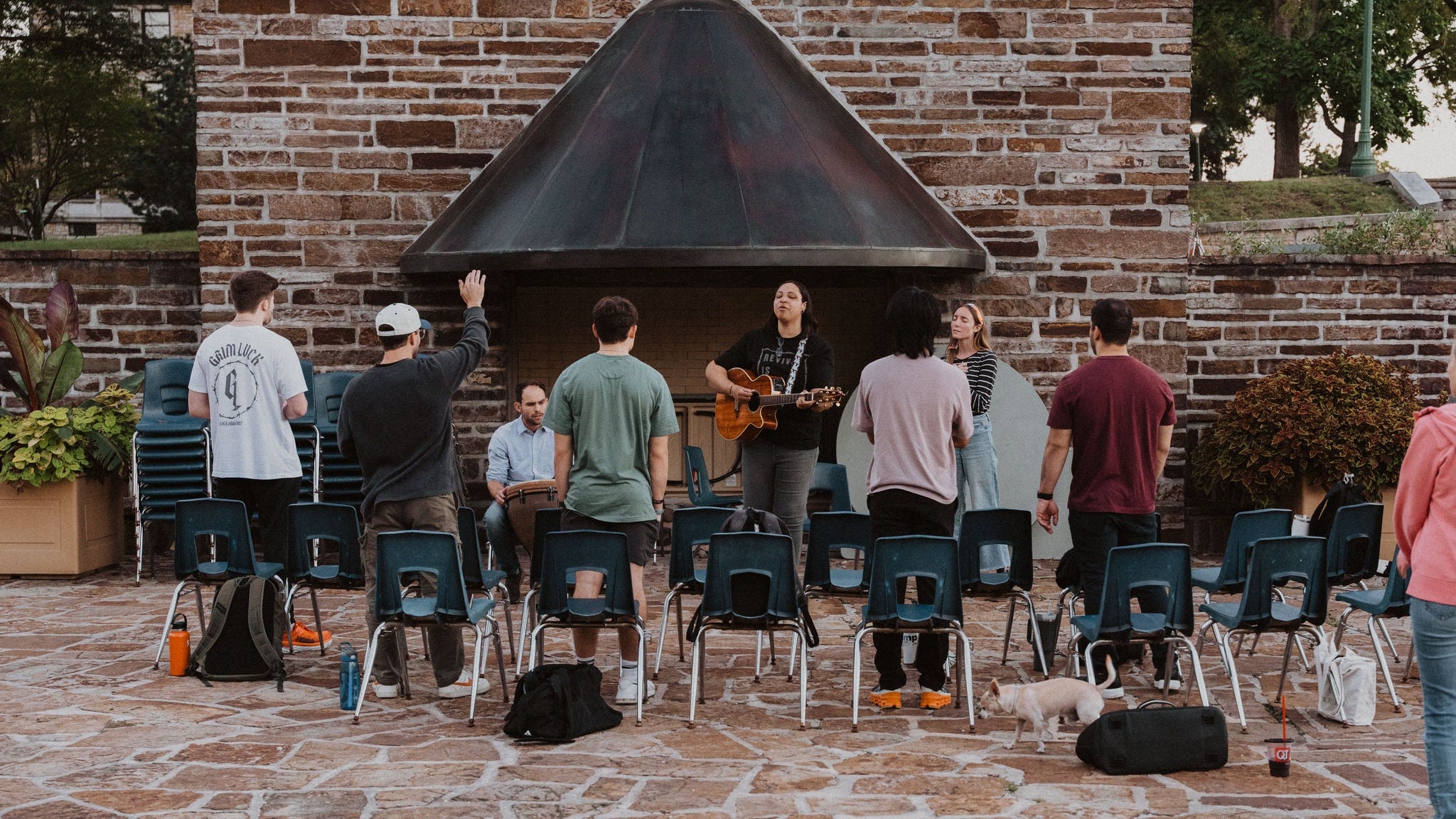
Today, we are called to this same reality: to be a praying family bound to each other in the Spirit of God and contending for another great awakening. Jesus prayed that we would be one, even as the Father is in Jesus and Jesus in the Father, so that the world may believe in Jesus (see John 17:21).
Unity is not the same as uniformity.
The Father and Son are one, but they are not the same. So often, we settle for being family only with those who are most like us and who 1 most agree with us. This mentality is the narrowest expression of family; it does not cost us very much. Paul exhorts us to “let love be genuine. Abhor what is evil; hold fast to what is good. Love one another with brotherly affection. Outdo one another in showing honor” (Rom. 12:9–10 ESV). We are called to genuinely love those who may be least like us. And we are called to honor and celebrate as family those who may greatly disagree with us.
How do we do this? We need to see our brothers and sisters in Christ—especially those who have different backgrounds, practices, traditions, and non-essential theology—through the eyes of Heaven. Our aim is the “unity of the Spirit in the bond of peace” (Eph. 4:3 NKJV). We need to grow past agreeing to disagree to the place of genuine love and honor for every part of the family of God. Only then can we come together as a united praying family in our city, nation, and generation.
Awakening is generational.
On Pentecost, after ten days of homothymadon prayer and fellowship, the promised outpouring came. The power and glory of that experience led to Peter’s first salvation message and an influx of believers. The upper-room family that started with 11 apostles and 120 disciples grew overnight into a megachurch with 3,000 new believers. In Acts 2, we see they developed a corporate lifestyle of devotion in the Word, prayer, worship, and fellowship. The Lord moved powerfully in their midst. Day by day, thousands of believers gathered in homothymadon worship in the temple and homothymadon fellowship in each other’s homes (see Acts 2:42–47). The signs and wonders of their family living out the consecrated life, the shared life, and the poured-out life together in John 17 oneness resulted in many more being added to the family of God every day.
How did this inexperienced band of disciples become effective megachurch leaders overnight? The secret was family. They had spent three and a half years doing family and ministry with Jesus. Then, they practiced what they learned during the 50 days between Passover and Pentecost. The disciples had seen Jesus with the multitudes. He had moments of ministry to the crowds, but He lived a lifestyle of one-on-one, one-on-three, and one-on-twelve discipleship. Jesus spent disproportionately more time investing in His core family of twelve than in pursuing seemingly strategic opportunities to gather large crowds.
Small is the new big.
When revival broke out in Acts 2, the disciples led as they had seen Jesus lead. They had larger public moments in the temple, but most of the ministry took place in homes, in the context of family. Daily, people came to faith in Jesus as they witnessed the gospel lived out in family. This pattern of house-to-house ministry continued as the early church grew (see Acts 2:46; 5:42; 8:3; 10:2; 12:12; 16:32,40; 18:7; 20:20; Rom. 16:5; 1 Cor. 16:9; Col. 4:15; Phil. 1:2). The Greek word here for house, oikos, can also be translated as “household” or “family.” This family-based home-group ministry model that the disciples had experienced with Jesus and were now replicating led to exponential growth in the early Church.

Family is the vehicle.
If revival broke out today and 10 percent of our cities came to Jesus, would the Church infrastructures be able to handle an influx of hundreds of thousands of new believers? Would churches gather in arenas and stadiums? Would they 2 employ online discipleship strategies? These are potentially viable options, but one biblical approach guarantees success: Mothers and fathers of our churches could open their homes to disciple the new sons and daughters and bring them into family. Though we have limited seating capacity in our sanctuaries and finite bandwidth for weekend services, we have a largely untapped army of believers.
We have yet to activate these treasures in our congregations and empower them to be fathers and mothers to the next generation. In Ephesians 4, Paul exhorts the leaders of the Church “to equip the saints for the work of ministry, for building up the body of Christ” (Eph. 4:12 ESV). Then he casts a vision for what healthy church family looks like: “Speaking the truth in love, we are to grow up in every way into him who is the head, into Christ, from whom the whole body, joined and held together by every joint with which it is equipped, when each part is working properly, makes the body grow so that it builds itself up in love” (Eph. 4:15–16 ESV).
In most churches, 10 percent of the congregation—pastors, staff, elders, and super volunteers—work really hard to make church happen. And 90 percent spectate. What if, instead, the 10 percent focused on equipping and empowering the 90 percent for the work of ministry? Then the onus of pastoring, mentoring, praying for, and doing family with new believers would be borne by the 90 percent. To prepare for upcoming revivals and rapid growth, we need to invite every believer to take greater ownership of the congregation, to be fathers and mothers in the community, and to become part of the core of the church who are equipping the saints for the work of ministry. In this way, our churches will be better positioned to steward the exponential fruit of coming spiritual awakenings.
This is for us today.
The invitation to engage the Acts 2:42–47 culture of family and lifestyle of prayer is as relevant and needed today as it was 2,000 years ago. We must recover the biblical wisdom of the homothymadon family—embracing the consecrated life together, the shared life together, and the poured-out life together. We need to put less emphasis on polished Sunday services and large conferences with big names, and instead focus on shifting our ministry culture to build from the context of family.
We need to learn to stop for the one. We need to learn to love well, with no agenda and nothing to gain. We must resist the urge to run when things get hard and instead choose the humility needed to work out conflicts. We need to grow in assuming the best, dying to self, and loving our neighbor as family. Only then will we be able to see the fullness of all the Father desires to do through us as His family so that together we “may with one mind [homothymadon] and one mouth glorify the God and Father of our Lord Jesus Christ” (Rom. 15:6 NKJV).
Presence Pioneers and Thai Lam invite you to participate in the Collegiate Day of Prayer, a global, multi-generational day of prayer for revival and awakening on college campuses worldwide on February 26, 2026. Learn more at collegiatedayofprayer.org.