
The Soul, The Song and The Spirit
Discovering the Power of Prophetic Worship

What is prophetic worship? Is it biblical? Is it necessary? While this specific phrase is not found in Scripture, the practice of prophetic worship is. What exactly is happening in these moments we might call “prophetic worship” in the Old Testament? And are similar practices valid for today?
My contention is that not only are they valid, but they are commanded. You, as a believer, are instructed in the New Testament to be filled with God’s Spirit and sing from your heart (Ephesians 5:18). This is not just for musicians, singers, and worship leaders. Christians are to be a prophetic people (Acts 2:17 I Corinthians 14:1). Christians are to be worshiping people (Colossians 3:16, Hebrews 13:15).
And as we embrace this invitation from the Lord to be prophetic worshipers, God will use us to release His power and His kingdom into the earth. This is incredible! Each one of us can become vessels of His glory. We can sing and change the world. Seriously. This will happen as we align our souls and our songs with the Spirit.
Defining Our Terms
I’m using the terms soul, song, and Spirit throughout this article to demonstrate a biblical pattern throughout the Old and New Testaments.
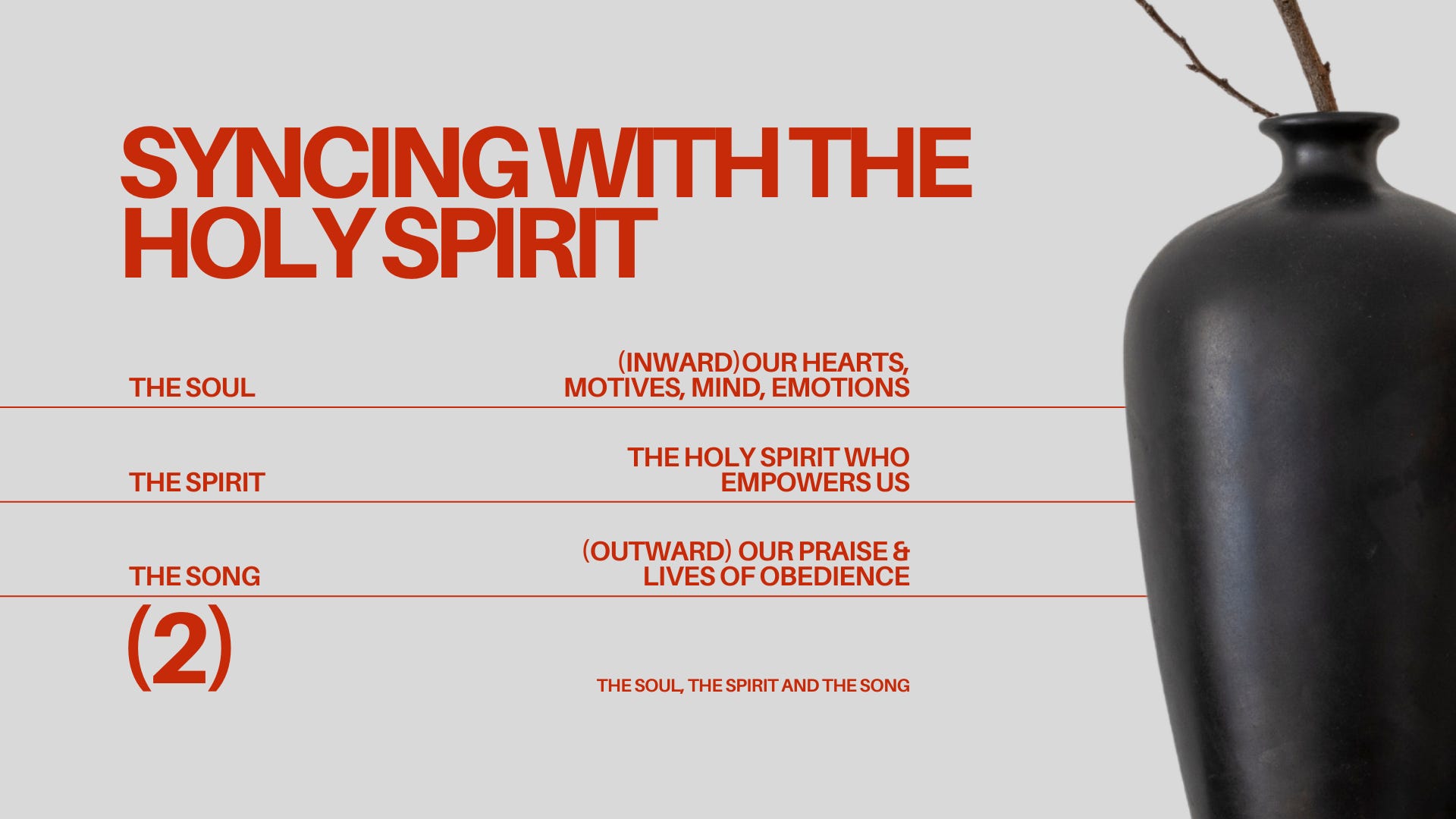
By “soul” I mean the inward aspects of our being. This would include our hearts1, motives, emotions, and minds.
By “Spirit” I mean the third person of the Trinity — the Holy Spirit who empowers us to follow Jesus and glorify Him
By “song”, I mean our outward expressions of worship and obedience to God. This includes our praise and corporate worship, as well as the way our everyday, holy lifestyles “sing” of God’s goodness2.
In other words, God’s desire is that our inner beings and outward lives would be in sync with the Holy Spirit.
Now that you understand how I’m using these terms, I want to examine how David exemplified a lover of God whose heart and song aligned with the Spirit of God. Then I want to show you what it looks like when any one of these (soul, song, or Spirit) is out of sync, so you can examine your own life and respond accordingly
Saul Anointed as King
You may be familiar with the tragic story of King Saul. The nation of Israel decided it wanted a human king. They chose Saul because he met their expectations of a king. Though he was hesitant, the prophet Samuel obeyed God and anointed Saul (I Samuel 10:1-4).
As soon as the ceremony was done, Samuel told Saul what would happen next (v 5-8). He would soon encounter a group of musical prophets. As we will see in another passage, these prophetic worshipers were Levitical musicians and singers whom Samuel had been training to play and sing prophetically. Here’s how Samuel described Saul’s upcoming encounter:
After that you shall come to Gibeath-elohim, where there is a garrison of the Philistines. And there, as soon as you come to the city, you will meet a group of prophets coming down from the high place with harp, tambourine, flute, and lyre before them, prophesying. Then the Spirit of the Lord will rush upon you, and you will prophesy with them and be turned into another man.
It might help to define prophecy. It is simply communicating God’s word to someone in the right place at the right time. It requires a sensitivity to God’s Spirit and a boldness to speak up when the Spirit is stirring. These prophetic minstrels were playing, singing, speaking, and playing God’s word. This is what I would call prophetic worship. It is praise, prayers, and declarations that express exactly what the spirit of God wants to express in that moment.
Samuel told Saul that this experience with prophetic worship would turn him “into another man”. God wanted the king of Israel to know that He manifests His presence in the midst of worship. And as I’ve said before, God’s presence changes everything.
When the event happened, Scripture says that God gave Saul a new heart, and the Spirit of God rushed upon Him. Talk about a powerful encounter with God!
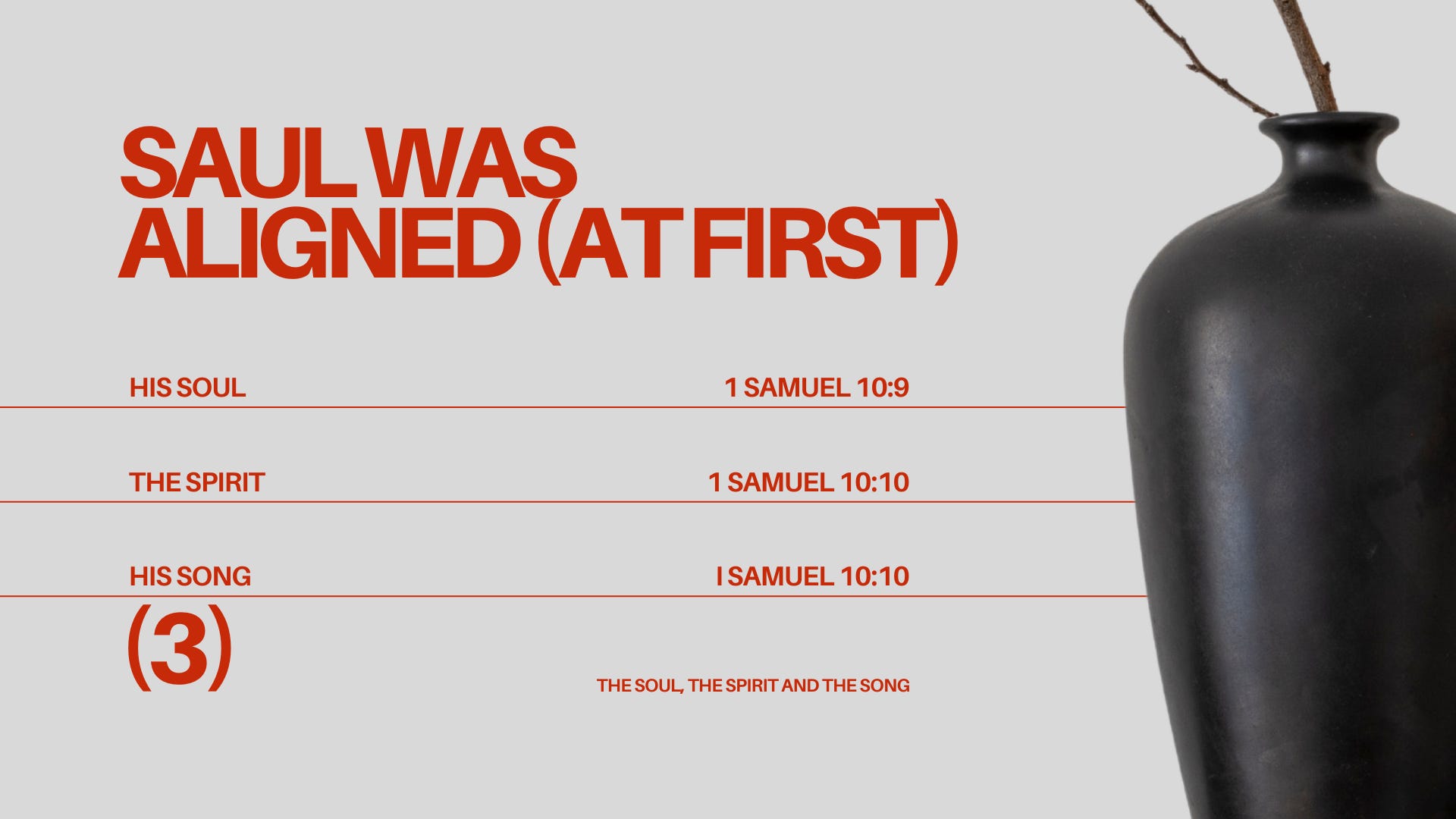
When he turned his back to leave Samuel, God gave him another heart. And all these signs came to pass that day. When they came to Gibeah, behold, a group of prophets met him, and the Spirit of God rushed upon him, and he prophesied among them. I Samuel 10:9-10
Where soul, song, and Spirit align on the earth, God’s kingdom breaks into that place. The prophetic songs of those Levites created an atmosphere in which Saul was transformed. In God’s manifest presence, we either change or run away. Saul entered that environment, was filled with the Spirit of God, and began prophesying. It was life-changing.
We expect this to happen because the Psalms say that God is enthroned in praises (Ps 22:3). God’s presence and kingdom break into environments of praise and worship. But not all songs are created equal. In this verse, the Hebrew word translated as “praises” is “tehillah”. This is one of several Hebrew words that are translated as ‘praise’. Tehillah is specifically praise that flows from the heart by the Holy Spirit. It has biblical connections to the idea of a “new song” (Psalm 40:3, Isaiah 42:10). And it is correlated to experiencing God’s manifest presence (Ps 100:4). Don’t just sing any song; sing a new song! A spontaneous song. A prophetic song. A song of the Spirit. Tehillah.
Initially, for Saul, there was alignment with his soul, his song, and the Spirit. God gave him a “new heart” (I Samuel 10:9). The Spirit of God rushed upon him, and the new king sang a new song (I Samuel 10:10).
Gradually, Saul’s heart turned from God. His pride caused him to disobey the Lord and come under judgment. Samuel told the king that God was going to remove him and put in his place one who was after God’s heart.
“But now your kingdom shall not continue. The Lord has sought out a man after his own heart, and the Lord has commanded him to be prince over his people, because you have not kept what the Lord commanded you.” I Samuel 13:14
Saul’s soul was no longer aligned and submitted to God. He may have honored God with his lips, but his heart wandered far from Him.
David Anointed as King
The “man after God’s own heart” referenced by Samuel was, of course, King David. The prophet Samuel journeyed to Bethlehem and anointed the young boy as the new king of Israel (I Samuel 16:1-13). After David’s anointing, God’s Spirit came upon him, and a distressful spirit began to torment King Saul.
Interestingly, just as Saul was taught about prophetic worship after being anointed as king, David also had a prophetic worship encounter after his anointing. Saul asked for a talented musician to soothe his torment, and David was chosen for the job. What happens next is incredible:
And whenever the harmful spirit from God was upon Saul, David took the lyre and played it with his hand. So Saul was refreshed and was well, and the harmful spirit departed from him. I Samuel 16:23
It was as if the Lord was regularly trying to teach the kings of Israel about the power of prophetic worship. I believe this is because God’s kingdom is intrinsically connected to praise and worship. The throne of God, from which He governs His kingdom, is an environment of day-and-night worship and prayer (Revelation 4:8). If God’s kingdom were to come in Israel as it is in heaven, then the earthly kings needed to learn to align with these heavenly principles.
The reality is that there is a spiritual realm we cannot see. There is a spiritual battle between the kingdom of God and the kingdom of darkness. Praise is one of the weapons God has given us to fight against the enemy of our souls. David was discovering this truth as he played his harp before Saul. It is wild that a Spirit-filled little shepherd boy from Bethlehem, with a heart for God, could dislodge the demons that were afflicting the king. Despite his earthly power and resources, Saul couldn’t deliver himself. Because the true source of the problem was spiritual.
Yet when we worship, God manifests His presence. And when the King comes, He brings His kingdom with him. Demonic stronghold begins to crumble. Light starts to shine into the darkness. Truth expels lies. Healing breaks into sick places. Souls in bondage get delivered. This is the power of God’s presence through prophetic worship.
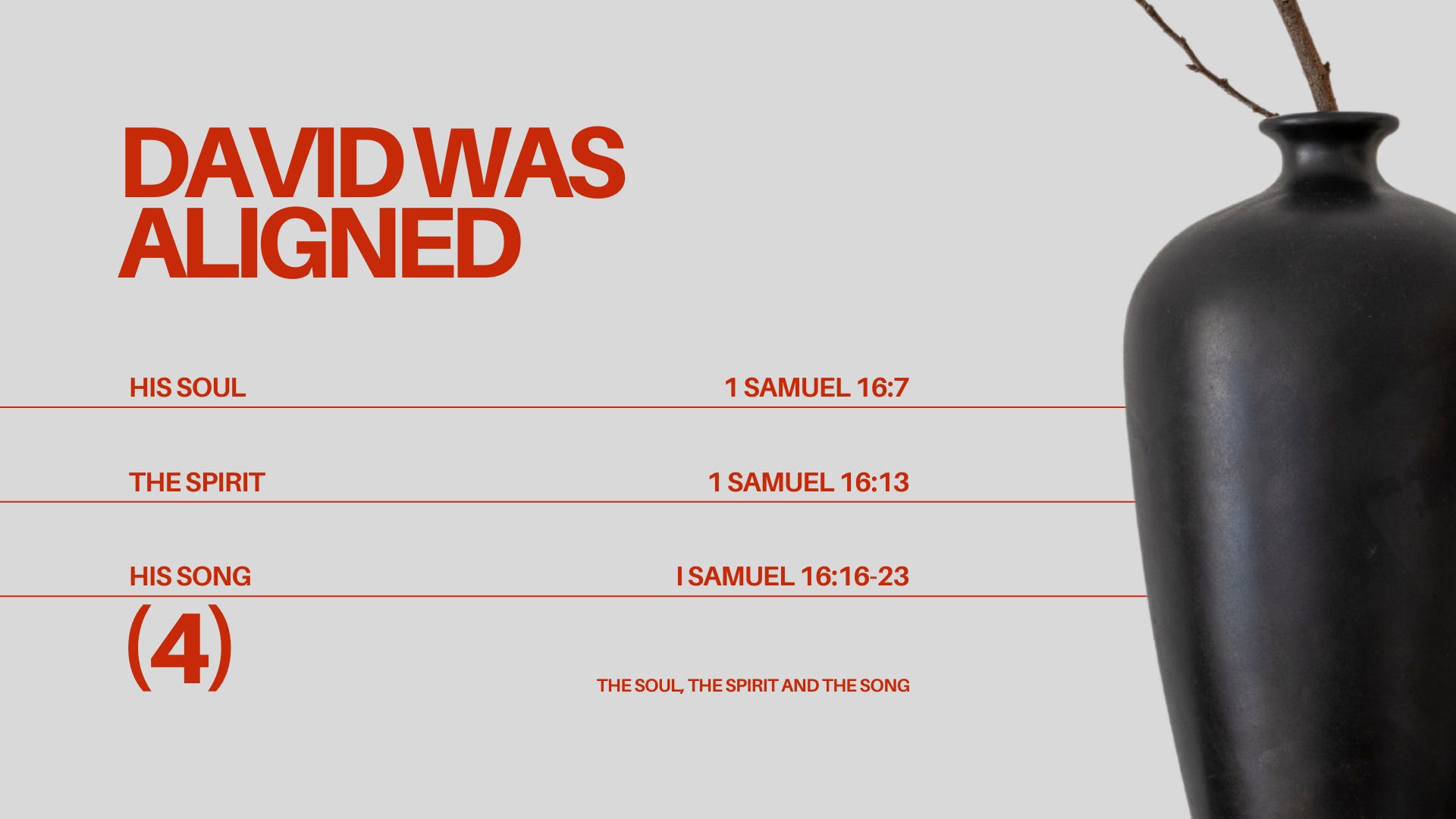
In this story, we see David’s soul (I Samuel 16:7) and song (I Samuel 16:23) aligned with the Spirit of God (I Samuel 16:13), and God’s transformative power was released.
But what happens when there is misalignment?
Three Dangers of Misalignment
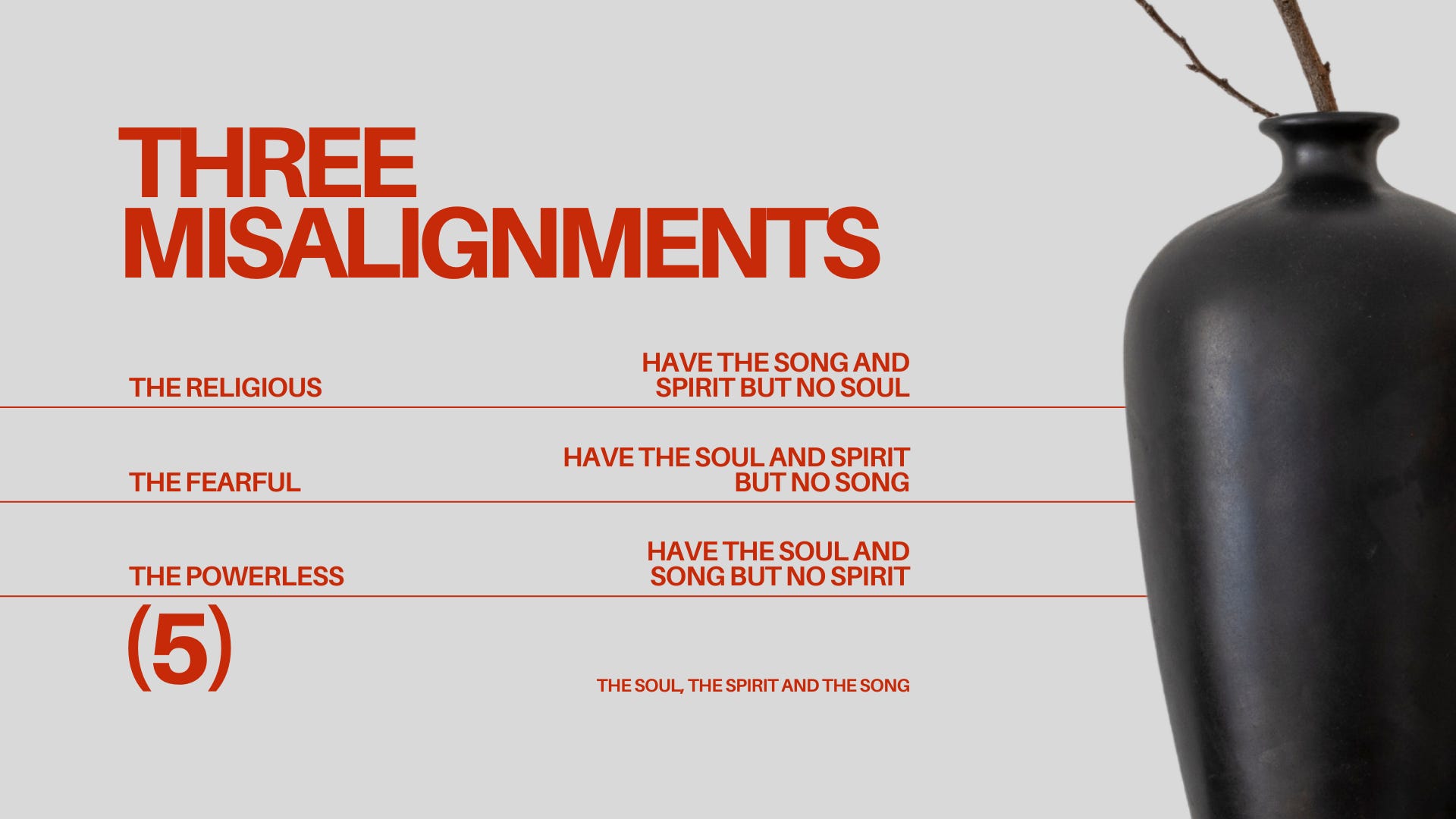
There are three types of people that emerge when one’s soul and song are not aligned with the Spirit of God. It’s likely that we have all been misaligned in these ways at some point.
The Religious - Song & Spirit, But No Soul
There are some who are doing the right things externally but whose hearts are not really wanting to honor God. Isaiah said it’s possible to honor God with our lips while our hearts are far from Him (Isaiah 29:13). Jesus said some will prophesy in His name, but won’t even truly know God (Matthew 7:22-23). Paul said it’s possible to prophesy but have no love in your heart (I Corinthians 13:2). The quality of one’s “song” is not a good indicator of the condition of one’s soul.
I use the term “religious” here in a negative way to describe those who do not have an authentic relationship with the Lord despite their impactful ministry or good deeds. Hypocrisy is a temptation for all of us. Our response when we find our souls drifting from the Lord is to repent. We realign our internal heart posture with our external actions to experience the healing and power of the Spirit again.
I know you are enduring patiently and bearing up for my name’s sake, and you have not grown weary. But I have this against you, that you have abandoned the love you had at first. Remember therefore from where you have fallen; repent… Revelation 2:3-5
This is exactly what happened to King Saul. It seems like he started his reign in alignment. The spirit had come upon him. It said that he received a new heart. He sang a prophecy with Samuel’s minstrels. Yet his heart drifted into pride, bitterness, and jealousy. Eventually, God removed him from his position and appointed David in his place.
The Fearful - Soul & Spirit, But No Song
There are some whose hearts are on fire for God, but you would never know it. Many sincere believers are plagued with fear. They may read their Bibles and pray in private, but they never express the extravagant worship that’s pent up inside their souls. They never share the Gospel or minister to others because they are afraid. They hide their light under a basket (Matthew 5:15). There is a song in their hearts, but they never sing. Proverbs 29:25 calls this “the fear of man,” and it is rooted in pride.
In order to break free from fear, we must 1) receive God’s love, which casts our fear, 2) be filled with the Holy Spirit, and 3) take steps of faith to release the chains holding us back. When we know God loves us, we can stop worrying about what other people think of us. It gives us confidence to obey the Lord freely. When we are filled with the Spirit, we are emboldened to walk out our Christianity with fresh power and bravery. This happened throughout the book of Acts, as scared believers were emboldened by fresh fillings of God’s Spirit (Acts 4:31).
Finally, the only way to break off fear is to take a risk. Start with a small step of obedience, and gradually step out more and more. Lift your hands in worship. Sing louder. Offer to pray for someone. Talk to a stranger about Jesus. Every step of faith and obedience will bring you into greater freedom as you align your “song” of your life with your soul and the Spirit.
King David experienced this firsthand. While bringing the Ark of the Covenant into Jerusalem, he danced wildly in worship before the Lord. His own wife, Michal, rebuked him for his extravagant worship. Rather than giving in to the fear of man, David looked to the Lord for his affirmation. He kept singing his song!
The Powerless - Soul & Song, But No Spirit
There are some sincere believers who are laboring for the Lord but seeing very little impact, power, or fruit in their lives. It is possible to be doing a lot of good things that are not God things. If you have not learned to walk in the Spirit, you may be missing out on the specific ways God wants to use you in a more powerful, impactful way. We as Christians need to learn how to hear God’s voice and be sensitive to the leading of His Spirit in all things.
If your life feels sincere but powerless, ask for a fresh filling of the Spirit of God. Before you sing your “song”, ask the Holy Spirit what He is singing. Join with what He is doing, rather than asking God to bless what you are doing. This is how our worship (and lives) become prophetic. Samuel’s minstrels weren’t just singing from the songbook. They were connected to God’s Spirit and prophesying the word of the Lord in that moment. This is a picture of how God wants us to worship and to live.
Be Filled with the Spirit and Sing From Your Heart
We see confirmation in the New Testament. Look at the apostle Paul’s instructions in Ephesians 5:
[18] And do not get drunk with wine, for that is debauchery, but be filled with the Spirit, [19] addressing one another in psalms and hymns and spiritual songs, singing and making melody to the Lord with your heart…
This passage encourages Christians to be filled with the Spirit and to sing from their hearts/souls. God wants us aligned: soul, song, and Spirit. Not just any songs. Songs from our hearts. And “spiritual songs”, which I believe are equivalent to the “new songs” (tehillah) of the Old Testament.
It is interesting that Paul is telling believers to be filled with the Spirit. Some teach that Christians are only baptized/filled with the Spirit once at the moment of salvation. Obviously, this is not the case, since Paul is urging the Church to be filled again. In fact, the Greek here is in the present progressive tense, indicating an ongoing filling of the Spirit. We need to be filled with the Spirit over and over again.
It’s Time To Get In Sync
What would happen if we started living and worshiping with our hearts and songs aligned with the Spirit of God? God wants to move through us to change people’s lives. We can become vessels of God’s glory and kingdom on the earth. We (the Church) can transform cities and nations.
Let’s repent and turn our hearts to the Lord. Let’s be filled with the Spirit to sing loudly and be bold. Let’s cast off fear and take steps of faith. Let’s listen to His voice and sing what He’s singing. When our souls, songs, and the Spirit get in sync, everything changes.
Some would want to distinguish strongly between one’s “heart/spirit” and one’s “soul.” Wayne Grudem makes a (convincing) argument in his Systematic Theology that these ideas are all the same biblically and refer to one’s “inward being” (that which is unseen).
While I’ll primarily be speaking about the power of corporate praise and worship, we can (and should) easily expand our definition of “song” to include our lifestyles inside and outside of the Church.
Encouraged as always my friend!
Thank you🙏